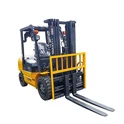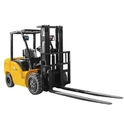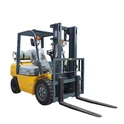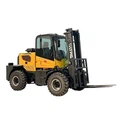

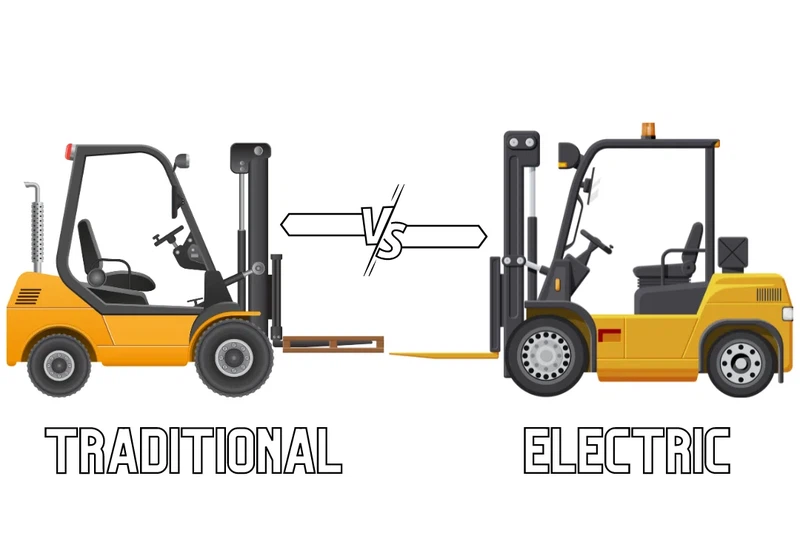
The rapid development of electronic control technology has made the operation of electric forklifts increasingly comfortable and expanded their range of applications. As a result, the market demand for electric forklifts is growing at an accelerating pace, and their market share is also expanding. In addition to their simple and flexible control operations, electric forklifts significantly reduce the physical strain on operators compared to internal combustion forklifts. Their electric steering systems, acceleration control systems, hydraulic control systems, and braking systems are all controlled by electrical signals, which greatly lowers the labor intensity for operators. This, in turn, greatly helps to improve work efficiency and accuracy.
Let's analyze which one is better by comparing the costs of electric forklifts and internal combustion forklifts:
Purchase Cost: Taking a 3-ton forklift as an example, the standard configuration ex-factory price of a 3-ton internal combustion forklift is approximately $8,300 (60,000 yuan), while the standard configuration ex-factory price of a 3-ton electric forklift with the same load capacity is approximately $16,450 (119,000 yuan).
Operating Cost: The cost of electricity consumption is much lower than that of diesel consumption. For a 3-ton diesel internal combustion forklift, the cost of diesel consumed per shift (assuming 40 liters of diesel per shift, with the vehicle consuming 5.5 liters of diesel per hour for 60 VDI cycles) is approximately $40 (288 yuan).
For a 3-ton electric forklift using an 80-volt 500AH battery (with a stored electrical energy of 8×500=4,000 watt-hours), the cost of operating a shift (discharging 80%, and charging at a 120% replenishment ratio, consuming about 40 kilowatt-hours) is around $5.53 (40 yuan). Of course, due to the implementation of new peak and off-peak time-of-use electricity pricing policies in various regions, it is more cost-effective to operate electric forklifts during the day and charge them at night.
Assuming an average daily savings of $19.35 (140 yuan), and with 250 working days in a year, the annual energy cost savings would be $4,838 (35,000 yuan). If we calculate for a 2-year usage period (with the battery's cycle life of 500 charge-discharge cycles for replacement), the energy consumption of an electric forklift can save $9,675 (70,000 yuan) compared to a diesel forklift. In fact, the charge-discharge cycle of an electric forklift battery can reach over 3,000 times at a 20% alarm level.
Maintenance Cost: The maintenance cycle for internal combustion forklifts is typically up to 500 working hours, while many electric forklifts can reach maintenance intervals of 1,000 to 1,500 hours or more.
Maintenance Content: The maintenance of electric forklifts is much simpler than that of internal combustion forklifts. It usually involves lubricating some jointed moving parts, such as mast bearings and steering bridges, with the main focus being on inspection and cleaning. At most, hydraulic oil is replaced every 2,000 or 3,000 hours. In contrast, internal combustion forklifts require engine oil and oil filter changes every 500 hours (usually around every 300 hours), hydraulic oil changes every 1,000 hours, and the replacement of belts (such as the engine timing belt and generator belt).
Maintenance Costs: Calculating based on 2,000 hours of operation per year, the maintenance cost for internal combustion forklifts is between $416 (3,000 yuan) and $555 (4,000 yuan) (for materials only), while the maintenance cost for electric forklifts is only between $139 (1,000 yuan) and $212 (1,500 yuan) (for materials).
Maintenance Time: Since electric forklifts have longer maintenance intervals compared to internal combustion forklifts, and each maintenance session takes much less time, this significantly reduces the labor costs associated with maintenance. More importantly, the downtime of the forklift is greatly shortened, and the economic benefits brought about by the increased efficiency of the forklift are immeasurable.
Comparison of Battery Replacement Costs for Electric Forklifts and Engine Overhaul Costs for Internal Combustion Forklifts:
If the battery life of an electric forklift is calculated based on a 20% alarm level charge-discharge cycle of 2,000 cycles, this translates to approximately 10,000 working hours for the forklift. This is roughly equivalent to the time required for a major engine overhaul of an internal combustion forklift. At this point, the cost of replacing the electric forklift battery is comparable to the cost of an engine overhaul. However, the speed of battery replacement is much faster than that of engine overhaul (or engine replacement), which again demonstrates an advantage in terms of time efficiency
LTMG is a professional forklift manufacturer and exporter based in China. If you have any questions about the forklifts or need to buy forklifts, feel free to contact us!
WhatsApp/Wechat: +86 13003982560
Email: Inquiry@ltmg.com