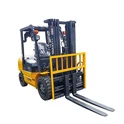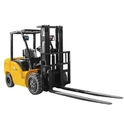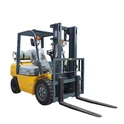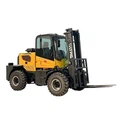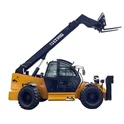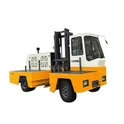


An airport baggage tractor is a specialized vehicle designed for transporting and towing passenger luggage at airports. These vehicles are typically built with high load and towing capacities to handle large volumes of baggage efficiently.
Features and Functions of Baggage Tractors
- Towing Capacity – Equipped with a powerful towing system, baggage tractors can connect to baggage carts or trailers, ensuring stable and efficient movement of heavy luggage.
- Load Capacity – These vehicles offer high load capacities, allowing them to transport multiple baggage carts or large luggage containers at once.
- Maneuverability – Designed for busy airport environments, baggage tractors provide excellent maneuverability, enabling smooth operations, including turning, braking, and reversing.
- Comfort and Safety – To ensure operator comfort and safety, baggage tractors are equipped with ergonomic seats, seat belts, collision protection, and other safety features.
- Versatility – Baggage tractors are capable of handling various types of luggage, including suitcases, parcels, and other cargo of different sizes and weights.
Evolution of the Airport Baggage Tractor Industry
The history of baggage tractors can be traced back to the early days of aviation. In the early stages of air travel, luggage was transported manually or with the help of animals. However, as aviation developed rapidly and the number of flights increased, airports required more efficient, faster, and more reliable methods for handling large amounts of baggage.
In the early 20th century, motor vehicles were introduced to airports, gradually replacing manual labor. Initially, modified trucks were used as baggage tractors to transport luggage. However, since these vehicles were not specifically designed for baggage handling, they had limitations in load capacity and maneuverability.
With the growing demand for air travel, the need for dedicated baggage tractors increased. To meet this demand, manufacturers introduced specialized baggage tractors with enhanced towing power and load capacity. These vehicles featured stronger engines and reinforced structures to accommodate the heavy demands of baggage transportation.
The introduction of electric technology further revolutionized baggage tractors. Electric baggage tractors reduce reliance on traditional fuels, offering lower noise levels and emissions, making them more environmentally friendly.
Over time, baggage tractor designs and functionalities have continued to improve. Modern baggage tractors are equipped with advanced control systems, enhanced safety features, and ergonomic designs to ensure efficient, safe, and comfortable baggage transportation. Some models even incorporate automation technologies, such as autonomous driving and navigation systems, to enhance operational efficiency and minimize human error.